Tuesday, August 28, 2007

Performing Better 2 Days a Week?

In what would be a somewhat strange turn of events, after cutting my training from 4 days to 2 days, I seem to actually be wrestling better. Right now, I get one class of gi training/drilling and one day of rolling (gi/no gi) for 90 minutes. (No, not 90 minutes straight) I have been doing this for a couple weeks now and noticed that my wrestling ability has actually increased. The only explanation that I can give for this is the fact that less time wrestling means less injury or wear and tear on the body.

Of course, I have also added 3 or 4 days a week of stationary bike riding so that has boosted my cardio to where it is noticeable helping my performance. Now, I am not hinting that I can perform at competition level, but as a hobbyist I am doing far better than I had been wrestling a few weeks ago.

Monday, August 27, 2007

Random Ramblings

I am in a half awake/half asleep mood so I thought I would combine a few random topics. First, I was able to view the first two matches from All Japan Pro wrestling which featured th Destroyer vs Mil Mascaras and I have to say these guys could WORK their butts off. These were great matches that still hold up well to this day and I recommend them to anyone who is a fan of old time wrestling.

Also, in the modern real world, I have been utlizing a casual exercise program of riding a stationary bike while reading and I have to say it has not only greatly increased my cardio, it has also increased my vocabulary. (ha ha)

BTW - I usually ride the bike for 45 minutes, but sometimes I might Sprint for 15 minutes and then go slow on the bike for 15. It is a decent program and it works well for gym training. Clearly it would have to be stepped up for tournament cardio

Thursday, August 23, 2007

Weight - Crushing Weight!

One of the most cool aspects of being a super advanced practitoner is the ability to deliver incredible crushing weight on an opponent when they are pinned. As much as I wish I could claim the mantel of having such a skill, I am not on that level. However, having experienced the crushing weight I can say I know what level I would like to reach. Let me explain this a little further.

Now, crushing pressure is not a matter of developing a secret system of mystical abilities. Rather, it is simply a matter of refining the basics to such a degree that the 'power' of the basics is significantly enhanced. In other words, the pin becomes a pin of tremendous amount of pressure. When you get pinned by an expert, you feel it. Actually, you feel like your sternum is about to snap!

What this ultimately shows is that if you invest your time in learning the basics and learning them well, you will do fine and you will become somewhat of a force to be reckoned with. While this may sound like hyperbole, it is actually much more mundane than you would imitially be led to believe.

Minor Changes

When it comes to improving one's game there is a misguided belief that many prescribe to that insists that the way to improve one's game lies in a massive overhaul of the person's performance. That is, in order to become a better wrestler/jiu jitsu competitor/etc there needs to be a huge influx of new techniques or material that is currently the fad or flavor of the month. This is far from accurate as often it is the implmentation of minor adjustments that can rapidly increase a person's ability to perform.

Beginners will often not realize this due to the fact that their awareness level is not what it needs to be in order to understand this notion of "shrinking the game" in order to improve it, but those who are experienced do. So, would you rather wrestle like a beginner or someone who knows what they are doing?

Saturday, August 18, 2007

Cardio is King

I know I sound like a broken record at times, but I really can not emphasize the importance of cardio conditioning because the epicenter of your entire game and performance will hinge on how well you cardio is. Yes, strength and technique count for something, but people seem to forget those attributes simply can not survive without a solid amount of cardio conditioning to support them.

That is to say when your cardio starts to diminish your game starts to dramatically slow down. Your reflexes slow and your ability to wrestle starts to slow. As the match drags on and on you keep slowing down to the point where you are at a virtual stop. Needless to say, even the worst wrestler will be able to clobber you when you reach rock bottom.

Now, some may feel this is important only when you are competing. That is a woefully inaccurate assessment of the importance of cardio. If you keep konking out in class, how are you supposed to get better? Answer: you can't. You need to keep your cardio at an acceptable level at all times.

Tuesday, August 14, 2007

Takada/Yamazaki and the UWF Circa 1985

I just finished watching a match from the long dissolved Union of Wrestling Force (UWF) between Nobohiko Takada and Kazou Yamazaki. For those not familiar with the UWF, this organization was company that was founded when some of the more "legit" wrestlers of New Japan bolted the company and formed a more realistic (yet still pre-determined) professional wrestling organization that would avoid anything that would not work in a real match. (Granted, those knowledgeable about submission wrestling will peg the matches as obvious works)

In 1985, the Wrestling Observer newsletter gave this match 5 stars and, honestly, I can not see why. The match is a solid and decent match and by 1985 standards must have been something unique to watch. However, it pales in comparison to the legit matches of the modern era. Regardless, this is still a unique match to watch as a time capsule in submission wrestling pre-history.

Thursday, August 09, 2007

When you throw, THROW!

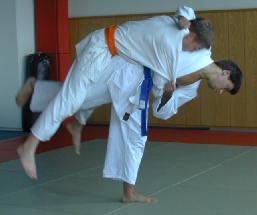
Here is somethine I noticed about people who have limited judo experience, but try to attempt throws within the context of another grappling sport such as Jiu Jitsu or Submission Wrestling. Taking the hip throw as an example, instead of launching the person into the stratosphere, there is a tendency to take the person and pull them onto the hip and them roll them off. Yes, this will get you two points, but what it won't do is incapacititate your opponent to the degree necessary to eliminate a counter attack. Hence, if someone does perform such a weak throw on you, this is prime time to counter.

If they person performs a throw that requires turning their back onto you and they do so in a manner that is basically weak, you have a prime chance of taking their back and choking them. If they do sort of half throw you, then you are in a great position to take an armlock or an armlock choke combo. (I believe this will nullify the two points one would normally get in sport JJ for a throw as the throw has been interrupted.)


So, if you are going to throw somebody, then you must THROW! them. If not, you are setting yourself up for a fall.

Wednesday, August 08, 2007

Refinement of Technique

This will probably be a subject that I will revisit time and time again. Here is pretty much a basic overview on my thoughts on the subject.

Far too often, instructors, book publishers and DVD vendors opt to cash in on a beginner's enthusism by delivering what th beginner truly wants: a massiv hodgepodge of techniques all provided so that the student can "learn" the art. This is about as flawed of a training module one can get for the simple reason that lumping a bunch of techniques onto the beginner's plate doesn't provide the student with 'real' knowledge. In other words, learning a ton of techniques and memorizing how to perform them on a static opponent simply doesn't translate into performance skill.

This type of approach is the exact opposite approach one must take to truly develop real skill which is the refinement of a few simple, basic techniques with the intention of developing solid working knowlege of the application of these skills within the context of a grappling bout.

Innovative Tutor Program

If you are looking for a means in which to improve your child’s academic progress, then you are well advised to peruse and consider Score Learning’s Innovative Tutor program as it is a brilliant program that can greatly aid in developing academic excellence in children ages 4 – 14. This is a unique program that Score has devised and those seriously interested in their child’s academic performance should visit Score Learning’s website for more information. Sponsored post.

Side Control Escapes - Moving Weight Down

When we first learn side control escapes, we are taught the basic hip escape/snake move way out of being pinned. The reason for this is obvious: this is probably the best way to escape as you can use it to put the person in your guard or use it as the impetus for going to your knees.

However, there is a certain psychological 'mess' that our mind is placed in we learn this technique because we ae essentially taught that this is the escape. What are not taught (or not taught often enough) is the simple common sense notion that the person pinning you is not just going to let you escape. They are trying to win too, remember? So, this creates the quagmire of the mind that the hip escape either doesn't work or that the person starts to believe that they are not good enough. With these sentiments, the student is simply beating him or herself up. What is needed on the students part is an understanding that escaping the side control against a resisting opponent requires incremental escapes. That is, you simply are not going to be able to hip escape from the person's hold with ease unless the person is a pure novice or was caught sleeping.

If you want a little tip in this area, you could try you incremental escapes by moving the opponent's weight downwards. That is, since the opponent is pinning your upper chest, you might be better off pushing the opponent's weight down towards your stomach so that you chest is not pinned. From this, you may gain enough mobility that you will be able to launch a more effective hip escape.

Tuesday, August 07, 2007

Speaking of those Dangerous Locks

One of my friends happened to be the unforunate recipient of a neck crank a few days ago and, well, it wasn;t a pleasant experience. In fact, he wasn't too thrilled that he was on the receiving end of a relatively mean spirited submission attempt. If anything, it shows that these types of submissions are not only injurious, they also provide the basis for a bad environment for training. In other words, it makes for the impetus of a negative environment that undermines all the positive benefits that can be derived from the true enjoyment of the sport. (Translation: some people are just flat out rude and obnoxious and ruin the class for everyone)

At one time, neck cranks were a major part of the game and they have been mercifully removed from the competitive equation. This was probably one of the wisest moves the 'powers to be' decided upon. Actually, the decisions did not come from any authoritarian figure as much as it was decided upon (wisely) by the collective. After all, how could the community stay united if aspects that clearly undermined the community were undertaken?

While it is true that sport jiu jitsu is a martial art, can we get beyond all the nonsense about self denfense? I mean, what is a more serious threat: the mythical streetfighter or the reckless person whom you may be facing in the gym

Saturday, August 04, 2007

Dangerous Things To Be Avoided

When Jigoro Kano devised judo, he based much of it around practicing things that you could train to the fullest. That is, you can't blast someone in the head with an elbow in training because you will hurt them. You can train an armbar without hurting anyone. Granted, in the 1880's Kano was limited by the non-existence of protective equipment.

Today, we have much protective equipment, but there are still some moves that should be avoided or outright eliminated from training. Consider neck cranks, for example. These locks were used quite a bit in jiu jitsu about a decade ago and have pretty much disappeared. There is a good reason for this: a broken neck or spinal injury is hardly something a person can bounce back from.

When people train, they train primarily for health, fitness and exercise. Yes, there is a competition component and a self-defense component, but most people train because they want an active hobby. Is it really worth the risk to injure yourself severely over a hobby. Additionally, if you are a sport competitor, would you want your career to go up in flames over a serious freak injury? This is why you don't see serious competitors play around with these types of submissions.

Again, you want to play safe and have fun. There is not reason to injure yourself or your opponent.

Wednesday, August 01, 2007

Are You Super Bad?

If there is anything we could point to that clearly defines the evolution of western cultural attitudes, it would be the fact the being a nerd is no longer a bad thing. Back in the 1970’s, HAPPY DAYS portrayed the ‘nerds’ as something to be vilified. Today, we have grown far beyond that as evidenced by the forthcoming nerd film extravaganza Superbad. Superbadis a film about a crew of quirky nerd friends who find themselves navigating the very awkward world of high school in a manner that is half poignant and half obnoxious and all humorous. Nerds are not known for tact and have a tendency to be somewhat crude (check out the multitude of trailers on YouTube,com for more info and, by the way, the “R Rated” trailer is pretty funny!), but it is this awkwardness that provides us with both laughs and a bit of sympathy towards the characters. Or, perhaps, what we feel is empathy? This is bound to be a cult classic with a huge following. Join the club and show a little support by visiting www.AreYouSuperbad.com where you can download ringtones, buddy icons and wallpaper. This looks like a fun movie and I will definitely be in the theater chuckling along at the proceedings. Don’t you think you should too? Sponsored Post

Standing Joint Locks As Throws

While I did mention in my prior posts that standing joint locks are not exactly my favorite martial arts techniques (in fact, I think they are a pretty bad idea) there are some valid uses for variants of these techniques. Namely, they can be used for throwing a person. If you will notice, fingerlocks and wristlocks are commonly used in traditional martial arts as a throwing technique. (Under the pressure of breaking a bone, the opponent "complies" with the direction of the throw) Yes, I know what you are saying, tradtional style martial arts are not where its at when it comes to valid techniques. Forget about the 'styles' of the tradtional arts for a second and look at the technique.

From a knowledgeable standpoint of the clinch and standing grappling, a person can integrate one's skill of wrestling, judo, Greco-Roman, etc as a means of controlling the body so as to snag the wrist for a wristlock throw. (Forget about the "he grabs me here and I do this" silliness or the even profoundly more silly catching a punch in mid-air and turning into a throw) Yes, the window of opportunity for these moves is pretty small, but you are not trying to prove whether or not a classical style works. You are simply integrating a move into your pre-existing game. If it works fine. If not, move on to something else. Whatever you do, however, do not get caught up in the game of trying to prove a technique works. That is usually a recipe for disaster.